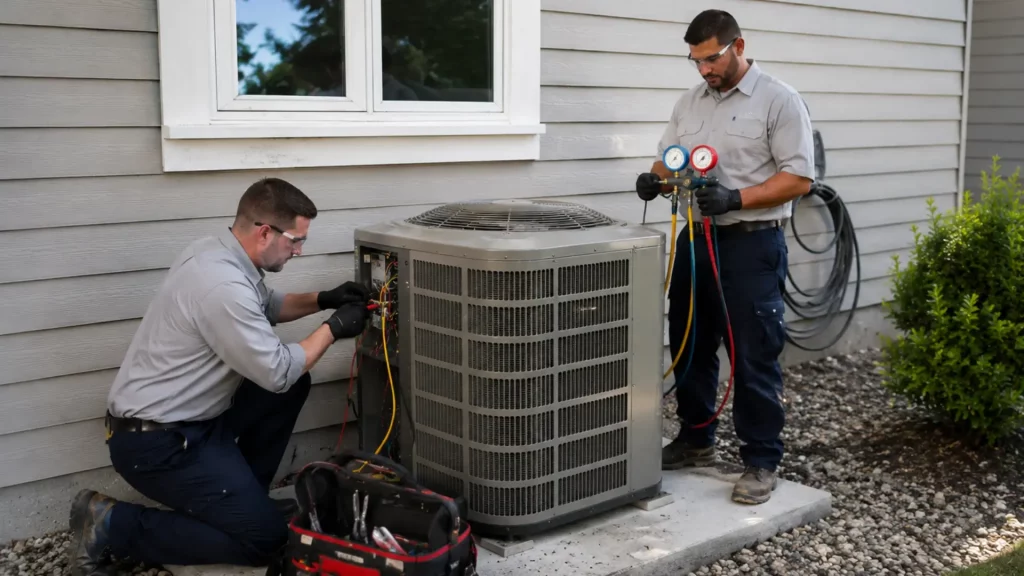
You may need emergency AC repair when your air conditioner completely stops cooling during extreme heat, develops an electrical or burning smell, repeatedly trips a breaker, leaks enough water to threaten your home, or shows signs of a serious mechanical failure.
In Las Vegas and Pahrump, an unexpected AC breakdown can become more urgent during periods of extreme summer heat. However, not every cooling problem requires an immediate service call.
Knowing which warning signs require emergency AC repair service and which problems can safely wait for a scheduled appointment can help you protect your home, your HVAC equipment, and the people inside it.
What is Considered an AC Emergency?
An AC problem is generally an emergency when it creates a safety concern, causes complete cooling loss during extreme heat, threatens property damage, or could lead to more serious HVAC system damage if operation continues.
Common situations that may require emergency air conditioning repair include:
- Complete loss of cooling during extreme heat
- Burning or electrical odors
- Smoke or sparks from HVAC equipment
- A circuit breaker that repeatedly trips
- Serious water leakage
- Severe or sudden mechanical noises
- A system that repeatedly freezes
- Signs of a significant electrical or mechanical failure
A minor comfort problem, by comparison, may be able to wait until normal service hours.
What are the Signs You Need Emergency AC Repair?
Some AC symptoms require more immediate attention than others. Here are the warning signs homeowners should take seriously.
1. Your AC Completely Stops Cooling During Extreme Heat
A complete AC breakdown can require emergency repair when outdoor temperatures are extremely high and indoor temperatures are becoming unsafe or difficult to tolerate.
This is particularly relevant in Southern Nevada, where air conditioning systems can operate for extended periods during intense summer temperatures.
Before requesting emergency service, you can safely check:
- Thermostat settings
- The air filter
- Whether the circuit breaker has tripped
- Whether supply and return vents are blocked
If the system is running but still not cooling, the problem could involve airflow, coils, refrigerant, electrical components, or another part of the cooling system.
2. You Smell Something Burning or Electrical
A burning or electrical smell coming from your AC should be treated as an urgent warning sign.
The problem could involve overheating wiring, motors, electrical connections, or other HVAC components.
If you notice smoke, sparks, or a strong burning smell, stop operating the system if it is safe to do so and arrange professional inspection.
Do not repeatedly restart an AC system showing signs of an electrical problem.
3. Your AC Keeps Tripping the Circuit Breaker
An AC that repeatedly trips its circuit breaker may have an electrical or equipment problem that requires professional diagnosis.
Resetting a breaker once after an isolated event is different from a breaker that trips every time the air conditioner starts.
Repeated trips can be associated with problems involving electrical components, wiring, motors, compressors, or excessive electrical load.
Rather than repeatedly resetting it, have the underlying cause inspected.
4. Your Air Conditioner is Making Loud or Unusual Noises
Sudden banging, grinding, screeching, or other severe mechanical noises can indicate a problem that should be inspected promptly.
Some noises are relatively minor, while others may indicate a failing or loose component.
A new, severe noise becomes more concerning when it appears alongside:
- Reduced cooling
- System shutdowns
- Burning odors
- Electrical problems
- Excessive vibration
If the noise is severe, turning the system off can help avoid continuing to operate potentially damaged equipment.
5. Your AC Unit is Frozen
Ice forming on an air conditioner is not normal and can indicate an airflow, coil, blower, or refrigeration-related problem.
A frozen AC may continue running while delivering little cooling, which can tempt homeowners to leave it operating.
Instead, shut the cooling system down and allow a qualified HVAC technician to determine why it is freezing.
Potential causes can include restricted airflow, dirty filters, blower problems, coil issues, or refrigerant-related conditions.
6. You Suspect a Refrigerant Leak
A suspected refrigerant leak requires professional HVAC diagnosis rather than a DIY repair.
Possible signs include:
- Reduced cooling
- Ice on the system
- Longer cooling cycles
- Hissing sounds
- Declining AC performance
Low refrigerant can indicate an underlying leak, so simply adding more refrigerant without finding the cause does not resolve the underlying problem.
7. Your AC is Leaking Water
An AC water leak becomes more urgent when water threatens ceilings, walls, flooring, electrical components, or other parts of your home.
Potential causes include:
- A blocked condensate drain
- A frozen evaporator coil
- Drain pan problems
- Condensate drainage issues
A small drainage issue and significant water accumulation do not carry the same urgency. If water is spreading or approaching electrical components, stop the system if safe and seek professional assistance.
Emergency AC Repair vs. Regular AC Repair: How Do You Decide?
The easiest way to decide is to consider safety, indoor temperature, property damage, and whether continued operation could worsen the problem.
| Situation | Emergency Repair? |
| Complete cooling loss during extreme heat | Potentially yes |
| Burning smell or smoke | Yes |
| Sparks or serious electrical symptoms | Yes |
| Breaker repeatedly trips | Prompt inspection recommended |
| Significant water leakage | Potentially yes |
| Severe grinding or banging | Prompt inspection recommended |
| Slightly reduced airflow | Usually scheduled service |
| Minor temperature difference between rooms | Usually scheduled service |
| Routine filter replacement | No |
| Preventive maintenance | No |
When Can an AC Problem Wait Until Regular Service Hours?
An AC problem can usually wait for scheduled service when there is no immediate safety concern, the home remains reasonably comfortable, and continued operation is unlikely to cause additional damage.
Examples can include:
- Slightly reduced cooling
- Minor airflow differences
- Gradually increasing energy bills
- Minor thermostat problems
- Uneven temperatures between rooms
- Routine maintenance concerns
However, symptoms can change. A minor issue that progresses into complete cooling loss, electrical problems, severe leakage, or unusual mechanical behavior should be reassessed.
What Should You Check Before Calling for Emergency AC Repair?
Before calling for emergency AC repair, check your thermostat, air filter, circuit breaker, vents, and visible condition of the AC system.
You can safely perform these basic checks:
- Check the thermostat. Make sure it is set to Cool and below the current indoor temperature.
- Check the air filter. A severely clogged filter can restrict airflow.
- Check the breaker. Determine whether the AC circuit has tripped, but don’t repeatedly reset it.
- Check the vents. Make sure supply and return vents aren’t blocked.
- Look for ice. Visible ice can indicate a system problem.
- Look for water. Check for abnormal water accumulation around the equipment.
- Listen and smell. Note unusual noises or odors that can help a technician diagnose the problem.
Do not open electrical compartments or attempt refrigerant or electrical repairs yourself.
Why Can AC Breakdowns Be More Urgent in Las Vegas?
AC breakdowns can become particularly urgent in Las Vegas because prolonged extreme summer temperatures place heavy cooling demands on residential air conditioning systems.
During periods of intense heat, AC equipment may run longer and cycle more frequently to maintain the thermostat setting. Gunny’s existing guidance on Las Vegas heat waves discusses how extreme temperatures can increase cooling demand and stress HVAC equipment.
The urgency of a breakdown also depends on the household.
A complete cooling failure may require faster attention when the home includes people who are especially vulnerable to extreme heat.
Does Pahrump Need the Same Emergency AC Considerations?
Yes. Homeowners in Pahrump can face many of the same cooling concerns during Southern Nevada’s hot weather, including complete cooling loss, electrical problems, refrigerant-related issues, and unexpected system failures.
Gunny’s serves both Las Vegas and Pahrump, so the article can establish relevance to both service areas without repeating both locations in every section.
Can Regular AC Maintenance Reduce Emergency Repairs?
Regular AC maintenance can help identify developing problems before some of them turn into unexpected breakdowns, although maintenance cannot prevent every AC emergency.
A professional maintenance visit may identify issues involving:
- Electrical components
- Airflow
- Filters
- Coils
- Condensate drainage
- Cooling performance
- General equipment condition
For homeowners in Southern Nevada, scheduling maintenance before periods of heavy cooling demand can also help prepare the system for summer operation.
When Should You Call for 24-Hour AC Repair in Las Vegas?
Consider calling for 24-hour AC repair in Las Vegas when the problem cannot safely or reasonably wait until regular service hours.
That may include:
- Complete AC failure during extreme heat
- Burning or electrical smells
- Smoke or sparks
- Repeated breaker trips
- Serious water leakage
- Severe mechanical noises
- A problem that could cause additional equipment or property damage
If you’re unsure whether your AC problem qualifies as an emergency, describe the symptoms when contacting the HVAC company so they can help determine the appropriate level of response.
Need Emergency AC Repair in Las Vegas or Pahrump?
Gunny’s Air Conditioning & Plumbing provides 24/7 emergency air conditioning support in Las Vegas and Pahrump, according to its current air conditioning service information.
If your air conditioner has stopped cooling or is showing signs of a potentially serious problem, a professional inspection can determine the cause and whether immediate repair is necessary.
FAQs
What qualifies as an AC emergency?
An AC problem may qualify as an emergency when it creates a safety risk, causes complete cooling loss during extreme heat, threatens property damage, or involves potentially serious electrical or mechanical problems.
Is an AC not cooling considered an emergency?
Complete cooling loss can become an emergency during extreme heat, particularly if indoor temperatures are rising quickly or heat-sensitive occupants are in the home. Minor cooling problems without a safety concern may be able to wait for scheduled service.
Should I turn off my AC if I smell something burning?
Yes, if you can safely do so. A burning or electrical odor can indicate an equipment or electrical problem. Avoid continuing to operate the system until the cause has been evaluated.
Should I keep resetting my AC breaker?
No. If the AC breaker repeatedly trips, don’t continue resetting it. Repeated breaker trips can indicate an electrical or equipment problem that needs professional diagnosis.
Is a frozen AC an emergency?
A frozen AC isn’t always an emergency, but you should stop operating the cooling system and have the underlying cause diagnosed. Repeated freezing can indicate airflow, coil, blower, or refrigerant-related problems.
Is an AC refrigerant leak an emergency?
A suspected refrigerant leak requires professional diagnosis. The urgency depends on the symptoms and severity, but refrigerant-related problems should not be handled as DIY repairs.
Does Gunny’s provide emergency AC repair in Las Vegas?
Yes. Gunny’s advertises 24/7 emergency air conditioning support for customers in Las Vegas and its service area.
Does Gunny’s provide emergency AC service in Pahrump?
Yes. Gunny’s currently lists Pahrump as part of its air conditioning service coverage and advertises 24/7 emergency support.